Showing posts with label Jewish. Show all posts

Friday, March 4, 2011

And Now for Something Completely Different

My recent excursions/pilgrimages/quests to the slowly-dying Borders has left me with a ton of new books. Duh. That should be obvious. The unexpected part is that because of this, some mystery of my psyche gives me the desire to revisit all my old books, the ones that haven't been properly appreciated. Does this make sense on any level? Oh wait; I don't care. Books!

Some recipes collections, though, I've been reading far too often. I've been through my Italian a lot, so that's out. Bittman likewise; not good for recipe browsing. I'm sick of staring at a computer screen, so the Internet is of no use to me. Not feeling fancy enough for Food & Wine or the Silver Palate, and tapas are too much effort for too little output. And so on, until I had all but whittled my options away.

And then my eyes alighted on a little-used hardback tucked away in a corner of the bookshelf: Sephardic Flavors. Hmm, that's one I don't use often. Neen & Do gave it to me a few years ago when they were experimenting with new flavours. But not knowing how to approach the food, I haven't made good use of it. Time to remedy that, methinks!

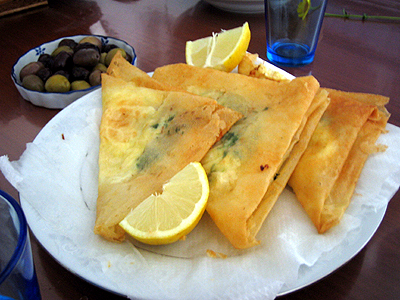
Scanning through the various options, none of which seem remotely similar to my standard cuisine, I eventually settled on mantikos. Evidently based on the Turkish manti*, these are palm-sized savory pastries -- kind of like warm bread dumplings filled with fresh cheese and [meat|onions|spinach] (the recipe offers three possible fillings). Somehow, they both taste delightfully Mediterranean and are bracingly warm for the remaining cold nights of winter. Making them was a bit of a pain, as I am very bad at wrapping up fillings without making a horrible mess. It turns out that it doesn't matter, though: if you can't pinch one mantiko (?) closed, simply let it cook on foil or parchment paper with the opening facing up. Even though some of the filling might escape, the rest can be put out on display.

And if, like me, you end up with too much filling, let me say one word: quiche.

Mantikos
for the starter:
  • 1 envelope (2,1/4 tsp) active dry yeast
  • 1/2 tsp sugar
  • 1 cup lukewarm water
  • 2 Tbs flour
for the dough:
  • 2,3/4 cups flour
  • 1 tsp salt
  • 1 tsp plus 1/3 cup vegetable oil
for the meat filling:
  • 2-3 Tbs olive or vegetable oil
  • 2 onions, chopped
  • 2 cloves garlic, minced
  • 1 lb ground beef
  • 2 tsp salt
  • 1 tsp freshly ground black pepper
  • 1/4 cup chopped fresh parsley

for the spinach filling:
  • 1 lb spinach, stems removed
  • 2 eggs, lightly beaten
  • 1/4 lb feta cheese, crumbled
  • 1/2 cup ricotta cheese, OR 1/4 lb kashkaval or gruyère cheese, grated
  • nutmeg, salt, pepper
for the onion and cheese filling:
  • 3 Tbs olive or vegetable oil
  • 4 large onion, thinly sliced
  • 1/2 lb feta cheese, crumbled
  • 1/2 lb ricotta cheese, fromage blanc, or cottage cheese
  • 2 eggs, lightly beaten
  • 1/4 cup fresh dill
  • pepper, nutmeg (optional)
to finish:
  • 1 egg, beaten with a little water

To make the starter, in a small bowl, dissolve the yeast and sugar in the lukewarm water, then stir in the flour. Set aside for 10min until frothy.

To make the dough, in a bowl, stir together the flour, salt, and the 1 tsp oil. Add the starter and using a stand mixer fitted with a dough hook, beat on medium speed until a soft dough forms, about 10min. Turn out the dough onto a lightly floured work surface and divide into 18 to 24 balls. Place the balls in a bowl, add the 1/3 cup oil, and toss to coat the balls with the oil Cover with a kitchen towel and let rise until almost doubled in size, about 30min.

Meanwhile, select one of the fillings and prepare it. If making the meat filling, warm the olive oil in a sauté pan over medium heat. Add the onions and sauté until tender and translucent, about 10min. Add the garlic and beef and cook, breaking up the meat, until the meat is no longer pink, about 5min. Add the salt, pepper, and parsley and continue to cook, stirring occasionally, until the meat is browned, about 10min. Remove from the heat and let cool.

To make the spinach filling, cook until wilted in the rinsing water clinging to the leaves, squeeze the spinach dry, and chop finely. Place in a bowl and add the eggs and cheeses. Mix well and season with the nutmeg, salt, and pepper.

To make the onion and cheese filling, warm the oil or margarine in a sauté pan over medium heat. Add the onions and saute until soft and golden, about 15min. Remove from the heat, place in a bowl, and let cool. Fold in the cheeses, eggs, and dill and season with pepper and with nutmeg, if using.

Preheat the oven to 350 degrees. Line 2 baking sheets with parchment paper. On a lightly floured work surface, roll out a ball of dough into a rectangle or square about 1/3-inch thick. Place a generous tablespoon of filling on the center of the dough. Fold in the sides, fold up the bottom, then fold the top over the bottom to seal. Pinch the seams together securely and place seam side down on a prepared baking sheet. Repeat until all the pastries are filled. Brush the tops with the egg wash.

Bake the pastries until golden, 25-30min. Serve hot or warm.


* Plagiarising the recipe notes: "Traditional Turkish manti are made with a kind of pasta dough and are usually dressed with paprika and melted butter or yogurt and garlic sauce. The Sephardic mantikos pastry from Cannakale is a yeast-raised dough."

Wednesday, November 10, 2010

Liver

I wish I had a camera to show you how beautiful my dinner is. Because who eats liver any more, anyway? Even at my somewhat elitist neighborhood grocery store, the chummy check out clerks who know me by name expressed their skepticism and dismay when I presented myself with a pound of beef liver, an onion, parsley, egg noodles (which I only later realized are "no cholesterol," a rather self-defeating perk given that they're being served with a POUND of liver), and 4oz of chocolate (for brownies!, I protest). Last week, in Paris of all places, where you'd think they'd refrain from turning up their noses to classic, simple preparations, Do and my best friend from high school bonded over their mutual disgust that I ordered seared veal liver with mushrooms at a restaurant. Of course, the only person who was actual French at the table is notoriously finicky (but lovable! very, very lovable!), so I probably shouldn't judge the whole country on that basis.

Liver is heritage. It's a cut that our great grandparents had absolutely no problem with, in the days before all American butchery was reduced to a mere dozen cuts of any given animal, unceremoniously bundled in styrofoam and plastic and discounted for 2.99 per pound. It is unctuous, like a rare steak or top grade salmon sashimi. It smells like earth mixed with blood -- life, really, in all its depth and raw-ness.

Here's how Julie Powell, of Julie and Julia fame, describes it in the first chapter of her new book, Cleaving (in which she becomes a artisanal butcher's apprentice, an ideal perch from which to wax poetical about under-appreciated cuts of carcass):

"I now slice off eight pretty burgundy flaps of liver. The cut organ releases a metallic tang into the air, and yet more blood onto the table. Changing knives now, I delicately excise the tight pale ducts that weave through the slices. Perfectly cooked liver should be crisp on the outside with a custardy-smooth center. Nothing tough or chewy should get in the way of that sensual quintessence. Six of these slices are for the gleaming glass and steel case at the front of the shop; the last two I set aside, to wrap up and take home after work for a Valentine's Day dinner tomorrow. Once, I thought the holiday merited boxes of chocolate and glittery cards, but in these last couple of eye-opening years, amid the butchery and wrenches of the heart, I've realized life has gotten too complicated for such sweet and meaningless nothings; I've even learned I'm okay with that." Julie Powell, Cleaving: A Story of Marriage, Meat, and Obsesssion, p.3.

Poetry. What a way to start a book! She then inserts a recipe for Valentine's Day Liver for Two, where she coats the beef liver with flour, and sears it on the rare side in butter, oil, salt, and pepper. That prose inspired my dinner tonight, but instead I used a recipe from Elizabeth Ehrlich's autobiography about acquiring a sense of self by learning to cook with her Holocaust-survivor mother in law. She devotes a whole chapter to learning how to cook liver, of which the sentences below are extracts:

"'Then we can start with the leybern.' Leybern - livers. Lukshn mit leybern: chicken livers with noodles. I am here to learn this, and next Friday, something else. For my husband, and for our children.
I remember my first taste of this dish. Just home from the hospital with Miriam's first grandchild, I found her in my kitchen, warming her pot on my stove and insisting I come to the table. The richness, the oil, the iron, the cholesterol, the onion, the salt overtook my body like an intravenous drug. Miriam beamed. "It's good," she stated. There had never been a dish like this one.
Many women of Miriam's generation and background have moved toward broiled fish or chicken. But Miriam stays with her chopping bowl, soup pot, and frying pan, with the old labor-intensive recipes, the rich and salty ways.
Can I use less oil, I wonder?"
Elizabeth Ehrich, Miriam's Kitchen, p.41-47

Miriam's recipe, which is the one that I made for dinner, is below. My comments are in italics.

Lukshn Mit Leybern. Serves 4.
1 lb chicken livers (I used top quality beef livers, because my butcher didn't have chicken)
1 large onion, diced (I'm tempted to use two next time)
Black pepper
1/4 cup vegetable oil
3/4 Tbs flour
3/4 Tbs sugar (I eliminated this, as unlike Polish Jews I don't fancy sugar in my mains)
1/4 tsp salt
Egg noodles, medium width (I used 1/2lb, could go with less).
Hot Water
Parsley, chopped, for color.
Clean livers. Slice into generous bite-size pieces. Broil gently until done, then drain on toweling to remove all blood (remember, this is a Kosher recipe).
Place onion in medium saucepan and sprinkle [generously] with black pepper. Cook on low heat until onion pieces sweat. [Or until you're so hungry you can't stand it any more.]
Add the oil to cover bottom of pan and onion. Mix. Saute until just golden. Stor in livers. Cook for a few minutes over low heat. Add the flour and sugar and mix together. Cover with hot water and simmer for 10 to 15 minutes over low flame. Add salt to taste. Simmer for a few more minutes. Serve hot on cooked noodles, sprinkle with parsely.

The broth tastes like that from a 6 hour long beef stew - the kind where you make your own beef broth from scratch with bones in order to enrich the broth with marrow. The richness of it all makes it kind of taste like Stroganoff... even though there's clearly no cream in it. I'm half tempted to add just a half teaspoon of mustard to emphasize the similarity. This isn't necessarily Liver at its most shocking - that would be seared, minimalist. But it's simple, honest. Rooted in another era.

And now, if you'll excuse me, I'm going to settle down with my bowl full of days gone by and my glass of wine, and enjoy.

Friday, September 18, 2009

Round Challah for Rosh Hashana - aka Victory Dance

It's traditional to bake round Challah for Rosh Hashana. I mentioned to Do this morning that I was just going to bake a normal round loaf, but he (knowing the best way to get exactly what he wants) went off on a long shtick about how much he loves my Challah, and how the braiding gives it this perfect texture, without the braiding it just wouldn't be the same, yadda yadda. On top of it, I haven't baked Challah for almost a year, so he's been deprived, yadda yadda.

So I give you *drumroll* braided round Challah. The things one does for a loved one. Before a dinner party, no less.

How fucking awesome does that bread look???? I can't wait to see his face when he comes home!


Braiding Instructions are here: http://alturl.com/bnof. The challah recipe is in this blog's files.

Sunday, September 6, 2009

[Trying to make] Brik. Or, why Julie Powell is dangerous.

[Continuing to explore Tunisian cuisine through Tessa Mallos' North African Cooking cookbook...]

I had to leave the kitchen. I put down my implements, left the hot deep-frying oil, marched into the bathroom, and dissolved into tears. Actually, I just crumpled and the wails erupted on their on. Have you read Julie and Julia? It was much more Julie Powell than Amy Adams, complete with irrational declarations that, clearly, the universe was over. Obvi. (Image from http://alturl.com/jbpf)

I had tried to make Brik. I had failed. The wrappers were brittle and were breaking, they weren't sealing around the filling, the egg yolks were bursting, the oil wasn't hot enough so the result was soggy, oily, egg-y, mess. Every single fire alarm in our apartment went off during the first minute and a half of my endeavor. Boiling oil splattered all over the clean stovetop, my clothes, my bare arms, everything. It was a DISASTER.

In one of Do's few memories of his great-grandmother, he was thirteen and visiting extended family in Paris, and his Tunisian great-grandmother made him brik. He still recounts the event with wonder and adoration. Brik are, essentially, deep-fried dough pockets filled with raw egg and a salty filling. The recipe in North African Cooking calls for anchovies and capers. About a teaspoon of the filling and a small raw egg get dumped into the center of a wonton wrapper (actual Brik dough is super time-consuming to make, my used-to-live-in-Algeria Mom informs me), the wonton wrapper seals around the filling, and the whole thing gets deep fried until barely crispy. As Do puts it: "It's salty, deep fat fried egg. What's not to like?" (The photo above is clearly not my creation. It was taken by Sheryl of the Crispy Waffle blog during her vacation in Tunisia, and can be found here.)

Fiasco. Bawling in the bathroom.

::Do Grabs The Talkie Stick ::

So, anyone that lives with a foodie knows all about managing explosions in the kitchen. I have generated a little check-list for myself.
After hearing loud shrieking/sobbing from Neen while she is cooking:
1. Check to make sure all limbs are attached. [If no - proceed to emergency first aid routine]
2. Remove any fire hazards from heat. (If something might overcook - remove that from heat too.)
3. Attend to Neen.

There were no missing limbs in this situation, but there was a fire hazards - so I turned the heat off on the oil before proceeding back to the bathroom to find out what was eating Neen. Now, it is worth mentioning that this is a VERY hard recipe, and I had known it from the start. I had tried unsuccessfully to convince her of this. So when Neen felt like she just couldn't make it work, the resulting meltdown was not completely unexpected.

[Neen: insertion] Actually, Do was trying very hard not to giggle. We had just seen Julie & Julia that afternoon, so the over-the-top explosion was just too stereotypical for words. Of course, his trying to suppress his smirk made me giggle... which was naturally followed by an especially loud wail to prove I was serious. [/Neen insertion]

Thankfully the solution to my portion of this problem was VERY easy - I just had her take bite out of one of the "failed" Brik she had just made. Fabulous - melt in in your mouth, salty, and rich. Everything Brik should be. So they weren't picture perfect, so what? Some of the wrappers didn't shut, but upon returning to the kitchen we realized that (of course) you are supposed to soak the wonton wrappers in water before using them - the recipe hadn't of course mentioned that! Once we corrected for this issue, we actually turned out some impressive-looking ones.

The happy ending to this story was a delicious meal of brik and white wine, set to candlelight. Perfection.

Neen: Yeah. Still not happening again any time soon. I'll wait to get hands-on instruction from the experts the next time we visit Do's family in Paris.

Brik bil Ancouwa (Brik with Anchovies)
a package of large spring roll wrappers
1 Tbs olive oil
1 large onion, finely chopped
1 1/2 Tbs fniely chopped canned anchovies
2 Tbs chopped parsely
3 tsp capers, drained
oil for frying
Small fresh eggs (Neen: this is critical)

Heat olive in oil in a small frying pan. Add onion and cook gently until very soft and translucent (~12-15min), stirring often. Add anchovies and mash in. Remove pan from heat, stir in parsely, capers, and add pepper to taste. Let cool.

Separate spring roll wrappers and soak ~5 or 6 in a bowl with cold water, to soften them. Add oil for shallow=-frying to a depth of 1/4" in a 10" frying pan and heat well. Open all the windows in your kitchen. Turn on air vent. Prepare your partner/brother/sister/child to handle the fire alarms if/when they go off.

Place one soft wrapped on a plate. Add ~1 Tbs anchovy filling in a heap on one side,with the edge of the filling just touching center. Make an indent in the filling and break one egg into it. Fold the wrapper over to enclose the filling and press the edges to seal. Try not to break the egg yolk, but if you do it's okay.

Slide brik immediately into the hot oil and shallow fry until golden brown and crisp, about 45 seconds on each side. Lift out and drain on paper towles. Repeat with remaining brik/filling. Serve immediately.

Wednesday, August 19, 2009

Quick and Elegant Salmon with Israeli Coucous Salad

Major success on the cooking front last night:

1. Had an unexpectedly delicious dinner
2. Rediscovered an old cookbook
3. Made up a successful dish from scratch
4. All prep took less than 20 min.

Did I say major success?

When we were planning the weekly menu last weekend, I picked up our copy of New Kosher Cuisine. It's a community cookbook that I'd gotten back in D.C. on recommendation from a good friend. It turned out to be too practical for our cooking style back then (though the Challah recipe is still our go-to challah recipe), but our interests and time constraints have changed radically in the past year or so. Like all community cookbooks it can be hit or miss, but I've gotten better at guesstimating what a dish would taste like based on reading the recipe. And oh man, was "Company Fish" a hit.

It's supposed to be a Shabbat dinner meal, when you have company over (hence the title of the dish). I'm not sure that would work for the super observant unless they were also super prompt (the fish needs to go straight from the broiler to the table, meaning your guests must already be home from shul and/or you don't mind using your broiler after sundown), but it's otherwise perfect for inviting guests over on a weeknight. The dish is super quick: since you marinate it ahead of time, it takes literally no more than 10min to have it from the fridge to the table. It's also quite impressive: strong complex flavors infuse all of the fish, and you really can't help but make sure the last drop of sauce is consumed. And the marinade ingredients are all standard (inexpensive) pantry fare -- what's not to like? Added bonus: the flavor of the sauce and the texture of the fish are on showcase here, so it's good for folks who are apprehensive about "fishy" flavors AND you don't need to feel compelled to buy expensive cuts of fish. Fresh fish, and voila.

The other success was the impromptu salad. Again, very simple: it was all ingredients we had in the fridge, and the chopping was the longest part. But it was so full of flavor and the freshness of summer that (don't read this part Mom) we totally started digging into the serving bowl with our forks once we we'd inhaled the servings on our plates. Great showcase for those uber fresh farmer's market veggies.


Israeli Couscous Salad
, serves 4 generously

1 cup Israeli Couscous
1 cucumber
1 beautiful heirloom tomato,
4 oz feta
1 small-medium red onion
2 lemons
1/2 cup chopped mint

Toast the israeli coucous in a little bit of oil, stirring regularly. Meanwhile boil water in a kettle. Once the couscous is toasted to your taste, pour ~2 cups boiling water into the pot (slowly, and stand back, it's pretty exciting). Simmer water for ~6min, or until coucous is done. Drain couscous, put into salad bowl.

Mince 1 red onion, chop 1 cucumber, 1 tomato, and 1/2 cup of mint, and all it all to the salad bowl. Crumble 4oz of feta into the bowl. Add the juice of two lemons. Salt and Pepper very generously.


Company Fish (New Kosher Cuisine cookbook), serves 8-10.
Neen: don't bother being too precise with your measurements. And don't be afraid to cut the recipe down -- fish is always best straight out of the oven.

1/3 cup soy or tamari sauce
1/2 tsp black pepper
1/4 cup fresh lime juice
2-4 cloves garlic, minced
1 Tbs Dijon
Grated zest of two limes (Neen: or a couple tsp lime juice, if that's what you have)
1/4 cup peanut oil
1/4-1/2 cup scallions, chopped
4 lbs ocean perch or salmon, skin removed.

Combine marinade ingredients in a small bowl. Place fish in a non-aluminum dish and cover with marinade. Refrigerate for 3 to 6 hours.

Preheat broiler. Broil fish 4 to 8 min until brown. Transfer to platter and spoon sauce over fish. Serve immediately.

Tuesday, July 7, 2009

Taking advantage of Tomatoes

Okay, first off: Psychgrad and R not only got married but also finished graduate school in the past month..!! I leave the foodie blog world for 12 months and it turns upside down! Do and I have felt a definite affinity for Psychgrad and R ever since we found them: they're some of the friendliest blogging folks around (along with co-blogger/MOB Giz) and their food/life/career situations seemed pretty similar to ours up until last month. Mazel Tov, you two.

Second thing: Fun new toy: Delicious.com. So last year, we had no good way of collecting and indexing the foodie blog recipes that struck our interest. We knew what blogs to turn to for certain recommendations (Lisa for Vegetarian Indian, for example), but didn't keep a virtual set of recipe clippings anywhere. No longer: delicious.com was made for people like us: it stores blog recipe links (no retyping the recipe or losing the photos), you create your own tags to organize the recipes, and you can share. So far, we're pleased and recommend it to others who collect blog recipes. And if your bored, our budding clippings collection is available at http://delicious.com/PostCollegiateCooking. Sweet!

Back to food. It turns out that none of our stock recipes really show off local, in season summer produce to its best advantage. Fall, Winter, and Spring we're starting to get a handle on, but we've spent the past 5+ summers moving around for internships or research or jobs. It's hard to devote much attention to culinary exploration when living out of a suitcase in a hostel or while driving all one's worldly posessions across the country. So expect to see a lot of tomato, squash, and fruit recipes this month.

Monday's dinner was a tomato and rice soup from Joyce Goldtein's Sephardic Flavors cookbook. To our initial disapointment, the cookbook focuses only on a small subset of Sephardic recipes, those from the eastern Mediterranean (Greece, Turkey, etc.). This recipe is supposedly an adaption of a Ma'min Jews of Salonika.

The recipe is little more than tomatoes and chicken stock, so we set out to acquire the best tomatoes within driving distance. We went to Berkeley Bowl West for the first time. For those not part of the cult (and only those who do not live within driving distance can choose not to be), Berkeley Bowl is the single best grocery store on the face of the planet. Michael Pollan shops there. People drive from the South Bay to shop there. It's supply of fruit and veggies is shocking: common veggies like tomatoes have 8 varieties on display (including heirlooms of peak ripeness), surrounded by shelf after shelf of exotics like yucca, star fruit, cacti leaves, edible flowers, etc. The dried goods sections are just as amazing, particularly their Asian sections. Seriously, if you ever visit the SF Bay Area, even if just for a weekend, you must visit this grocery store. AND, unlike the rest of us poor souls, you can completely bypass the original downtown Berkeley Bowl with its cramped aisles and overcrowded parking. The new one has ample parking, is located in the industrial part of town near the highway, and is freakin' gi-normous. Look Below:


So we
went there to get our heirloom, peak ripeness tomatoes and Do walked out with something like 10 additional pounds of fresh fruit. Anyways, we get back to the apartment, still glowing from our first visit to Berkeley Bowl West, and I set about making the soup... and finish just minutes after Do has finished unpacking our groceries. Now, that says something about how much we bought, but it also says that this is a ridiculously easy and convenient recipe. A trait much appreciated by working grad students.

How did it taste? Refreshing. Like Perfect summer tomatoes, only better. This was no apathetic tomato juice: it had body and slight spicing coming from the chicken stock. The rice and tomato pulp added texture and heartiness. And I thought the lemon wedges were a brilliant addition: zingy, adult, and even slightly exotic to our American palate. I don't think that this recipe will work with anything but the best summer tomatoes, so take advantage and try it now!

Summer Tomato and Rice Soup

2 Tbs Olive Oil
3 lbs very ripe tomatoes, coarsely chopped
3-4 cups chicken stock
1/2 c white rice (add an extra 1/4 if you want an extra hearty soup)
Bold3 Tbs chopped fresh parsley or basil
Lemon wedges

Warm olive oil in a large saucepan over medium heat. Add tomatoes and cook, stirring often and smashing them down with a wooden spoon, until they break down completely into a puree (~10min).

Meanwhile, heat chicken stock to a simmer in a soup pot. Add rice and tomatoes to the pot and bring the mixture to a boil over high heat. Reduce heat to low and simmer uncovered, stirring occasionally, until rice is tender (~15-20min).

Season with salt and pepper and stir parsley in. Ladle into bowls and pass the lemon wedges at the table.

Tuesday, July 29, 2008

Good Day: Front Stoop Visiting and Recycled Leftovers

Yesterday was a good day. An old friend called while I was making dinner: she was walking someone else's dog and wanted to swing by. A couple of beers later, some homemade tomatillo salsa, and our front stoop was used exactly as it was meant to: for impromptu visiting. Our upstairs neighbor swung by and chatted, we all petted the dog. It felt so... endearingly neighborly. Like out of a fairytale book for urban planners.

The easygoing setting fit right in with the company: B. and I met two summers ago in Ségou, Mali, where we were both doing research for our undergraduate theses. It was a very West African meeting ("Ah, you seem to be a friend of my friend! Can I sleep in your one-room house for the next 7 days?"). B was studying the Tuareg people and how their cultural identity changes as they migrate south from the Timbuktu area; I was studying Jeffrey Sachs' Millennium Village Project (ever heard of the One Campaign?). B. had been in Ségou for a while and spoke Bambara, the local dialect, so I stuck to her like glue and we became quite close. But then the summer ended and we returned to our respective Universities to write the darn theses and finish our senior year. So imagine how cool it was when, almost exactly two years later, on my very first day in Oakland, B. and I bumped into each other at an intersection!

By the time B. and I had caught up on the past two years, we'd polished off our beers and made a serious dent in the tomatillo salsa (hey, talk about a great way to use leftover Enchilada ingredients!). B. took the dog home and I went back to the less endearing activity of turning almost-dead leftovers into dinner.

As this post and this post show, I have a history of being completely inept when it comes to recycling leftovers. It doesn't help that our new fridge was not set to a sufficiently cold setting and our food spoiled faster than normal this past week (the problem is now fixed, but our compost bin is a lot fuller). A potato, three carrots, and some sour cream had survived the initial massacre, but needed to get used pronto. Remarkably, my brain clicked... how about a kugel?

My brain doesn't usually put two and two together and come up with a delicious dinner (definitely more than the sum of its parts). It's just not how I think, even though I've been wanting to try kugel for a while now and have several recipes bookmarked. No, shamefully, kugel occurred to me only because I had just spent the afternoon at San Francisco's Contemporary Jewish Museum. Side note: they have a lovely exhibit on William Steig, the guy who wrote Shrek!, Sylvester and the Magic Pebble, Doctor De Soto, Amos & Boris, and who was a New Yorker cartoonist for 73 years. Does anyone else remember his books from their childhood? I now know that "Shrek" is Yiddish for "Fear."

So, improvised Potato Kugel it was. I've been wanting to make Kugel because, reading ingredient lists, I just couldn't imagine what the final product would taste like. And you know, it wasn't half bad. The texture was a cross between a casserole, mashed potatoes, and an omelet. "A very German texture, very creamy," Do adds. It could have used more mustard, maybe some paprika, and Do felt that it absolutely shouldn't be any sweeter (there go my aspirations for Apple Kugel or sweet kugel. Do other folks serve these as desserts?). But for a first try, with no Ashkenaz cooks or cookbooks in sight, I think we did just fine. In fact, we'd like to share the Kugel at Ben's new bi-weekly I love Baking event. In the mean time, anyone have any tips, stories, or insights on Kugel?

It was a good day.

Potato-Carrot Kugel (serves four as a side)

1 potato, cut into chunks
3 carrots, cut into chunks
1/3 cup milk
2 large eggs
1 cup Parmesan, grated
Half an onion, sliced
3 Tbs sour cream or plain yogurt
2 Tbs mustard (maybe more)

In a medium saucepan cook potatoes and carrots, covered, in boiling water about 12 minutes or until carrots are tender.

In a large mixer bowl, mash potatoes and carrots with a potato masher or an electric mixer on low speed. Gradually beat in the milk till mixture is creamy. Stir in eggs, the 1/2 cup of parmesan cheese, onion, mustard, and sour cream or yogurt. Transfer to a 1-quart casserole.

Bake, uncovered, in a 350F oven for 20 minutes. Sprinkle with leftover Parmesan cheese, and bake for 15 minutes more, or until center is set.


Tomatillo Salsa (makes 3 cups)
1 1/2 lb tomatillos
Half an onion, chopped
1/2 cup cilantro leaves
1 Tbsp fresh lime juice
1/2 teaspoon sugar
3 Jalapeño peppers, stemmed, chopped
4 tsp ground cumin
Salt and black pepper to taste

Remove papery husks from tomatillos and rinse well. Cut in half and place cut side down on a foil-lined baking sheet. Place under a broiler for about 5-7 minutes to lightly blacken the skin.

Place tomatillos, lime juice, onions, cilantro, Jalapeño peppers, sugar, and cumin in a food processor (or blender) and pulse until all ingredients are chopped and mixed. Season to taste with salt and pepper. Cool in refrigerator and serve.

Thursday, April 24, 2008

Modern yet Comforting Matzah Ball Soup, by a first-timer

Let's do the sensual before the esoteric for once, shall we? Sort of retroactively taking up Psychgrad's suggestion to do the food before the ritual. :)

Do is now addicted to this Matzah ball soup. He has literally eaten it for three out of the last four meals, and has added it to his mental "must repeat once a month" list. Which is about as successful as a recipe can get in our house!

The soup itself is scarily easy to make (more on that later) and yet has a surprisingly deep chicken-y flavor. This is no insipid liquid that barely hints that someone may have once waved a chicken over it. This is punch-you-in-the-face chicken flavor. This may be because you add chopped roasted chicken late in the game (Thank You, local super market rotisserie!), which comes with its own set of spices and flavors that boiled chicken just doesn't have. The behind-the-scenes support staff, the veggies, are also doing more than their fair share of the work in the flavor department, I speculate because they get chopped very very finely in the food processor. As a result, more flavor leaches out of the veggies into the soup and you aren't distracted by hunks-o-veggie while eating. Oh and I speculate that my soup (above) would have been almost as clear as the Food & Wine photo (below) had I not spontaneously added chopped mushrooms to mine.

The Matzah balls, Do assures me, were also a success. They're spongy and light, yet they soak up chicken soup like a camel in the desert (Manna for my Men and Matzah ball soup for my Horses? No? No one listens to Toby Keith here? Maybe that's just Do's bad taste rubbing off on me). So it's like biting into chicken soup in solid form. I think they look kinda ugly, maybe like brains, but Do assures me that Food&Wine must have used golf balls in their photograph (see left), because no one's Matzah balls look that good. I think that this was my first attempt ever at Matzah balls, so they'll only get prettier with more attempts.

The last component, the dill-horseradish pistou, was really what took this version of the age-old classic to the next level. It was brilliant. It's essentially a pungent sauce exploding will dill and horseradish flavor. Extremely refreshing, extremely interesting, and forcefully inserts a light, fresh flavor into the otherwise heavier flavor of chicken soup. It reminded me of Scandinavian flavors. And it's beautiful. An impressively insightful modification to the classic: it takes chicken soup from the realm of the stuck-in-bed-with-the-flu and elevates it to High Holy day mode. Congratulations, Food & Wine, you really outdid yourselves on this one.

It was scary as shit to make though; at least 4 times during assembly I was convinced that it would be a total failure. The pre-cooked Matzah balls had an odd consistency and wouldn't really hold their shape. And then, I was convinced that they would stick to each other while simmering, and that I'd wind up with one giant glob-o-Matzah at the bottom of my pot. And then, I was pretty sure they looked like brains. And then, the chicken soup itself is so scary simple that I was sure it would taste just like tinned chicken stock. Let us say, it was an experience replete with adrenaline rushes.

Now for the mildly esoteric. I think it really says a lot about Judaism as (interchageably) a religion, a faith, and/or a family heritage/identity that Chicken Soup, chicken soup, is traditionally served on one of the High Holy days. It's in no way glorious, awe-inspiring, or intimidating. Instead, the focus is on a dish that is comforting and home-y, that creates the feeling that you are taking care of/being taken care of by the family and friends around you. I mean, it's soup, for goodness sake! It excels at producing warm and fuzzy feelings! How cool that it's traditional to serve a dish that brings out and prioritizes those sentiments. I dig that. I'm a-ok with religious observances that revolve around chicken soup.

(And yes, Matzah Ball Soup is traditional only among a subset of Jewish families, particularly those of Ashkenaz descent. For all I know, other Jewish cultures may serve a different dish that is equally warm and fuzzy. Me and my WASP-y preconceptions are taking this all in from a very subjective point of view. Speaking of which, if you want to read more about our intimate Monday night Seder, be my guest!)

The original version of this recipe comes from the Food & Wine magazine, but the version below represents my improvements (er, modifications).

Matzah Ball Soup with Dill-Horseradish Pistou (F&W claims that it serves 4, we found it served 6)

For the Matzo Balls:
4 large eggs, beaten
Half of 1/3 cup olive oil
1/2 cup seltzer or club soda
1 tsp kosher salt
1 tsp ground pepper
1/2 tsp ground ginger
1 cups Matzo meal

For the Pistou:
1/2 cup extra-virgen olive oil
1 cup coarsely chopped dill
2 Tbs finely grated horseradish
1 garlic clove
1 tsp salt
1/2 tsp ground pepper (we used Lemon pepper, since we had some on hand)

For the soup:
Carrots, finely diced (I used all our leftover carrots, which was probably 1/2 pound. Allow me to recommend the food processor)
Other veggies, finely diced (F&W used a medium turnip and a celery rib; I used 4 leftover button mushrooms).
3 quarts chicken stock (F&W recommends homemade; we are lazy and used storebought)
4 cups diced chicken (3/4 inch) (we highly recommend buying a rotisserie chicken from the grocery store, as it saved you time and tastes better than boiled chicken)
  • Make the Matzo Balls: In a bowl, whisk the eggs with the olive oil, salt, seltzer, pepper, and ginger. Add matzo meal and stir until moistened. Refrigerated until firm, at least two hours.
  • Line baking sheets with wax paper. Scoop the Matzo meal mcture into 1" balls (really. Keep 'em small. Unlike with cookies, bigger isn't better.). Using lightly moistened hands, roll the matzo balls until smooth. Transfer to the baking sheets and refrigerate the matzo balls briefly.
  • Meanwhile, make the pistou: In a food processor, pulse the olive oil with the dill, fresh horseradish, garlic, salt and pepper until the dill is finely chopped and a sauce has formed. (At this point, you can stop and fridge everything overnight if you wish).
  • In a large pot of boiling salted water, simmer the matzo balls over very low heat, covered, until they are plump and cooked through, 25-30 minutes.
  • Meanwhile, in another large pot, heat the stock. Add the finely diced vegetables, cook 5 min until crisp-tender. Using a slotted spoon, transfer the matzo balls to the soup; simmer for 5 more mnutes. Add the chicken and cook until heated through.
  • [You may want to let the chicken sit in the soup for a bit (10 min), to let the flavors mingle. I had to because Do was late coming home, and I think it made a big difference]
  • Serve the soul in bowls with a dollop of dill pistou.

Wednesday, April 23, 2008

Creating Traditions: Passover Lite and Spiced Charoset

I'm simultaneously intrigued and intimidated by Passover. Intrigued because it's such a "Family food" holiday, to quote D: at its center is the dining room table and a family-friendly set of prayers and stories and symbolic foods. It's so cool that arguably the most fundamental biblical event is commemorated within the intimacy of the family circle. I'm charmed, perhaps because I'm a sucker for all things symbolic (oops, is that my Episcopalianism showing?). But I'm also intimidated: one of the primary purposes of the holiday is to remember and reaffirm membership in the Jewish family at large. Last time I checked with my mother and my priest, I'm not Jewish. And yet this year, I was the one who assembled the Seder plate, set the table, and made dinner. Hmm. Walking the walk of an interfaith couple definitely provides food for thought.

[D Steals Talky Stick and Runs to the Corner of the Room]

Well, while Neen is not a Jew, I am. I had better clarify: I am a 30-minute Jew. If observance takes longer than 30 minutes at a sitting, it had better be Yom Kippur - for anything else, it just isn't going to happen. So when it comes to Seders, well you can imagine. As far as I can glean, a proper Seder, in my Grandfather's tradition, takes approximately 5-6 hours. It starts around sunset and food is finally served around midnight. It is amazing to me that he managed that with 4 children in the house.

I don't have the attention span for that - so when it comes time for a Passover Seder, I turn immediately to a nifty little booklet called 30 Minute Seder. Despite the cheesy main-page, the actually Seder guide is well put together, and - best of all- thin! It covers all of the most basic mitzvot with little explanations for those of us who have no clue what the bitter herbs are supposed to symbolize, or who might not realize that a hard-boiled egg is to commemorate Jewish midwives (?!). Though I admit, the absolute best on our Seder plate was the bone that represents the strong arm of God - let me just say, the little chicken thigh bone was almost hilariously puny looking. But I get ahead of myself.

The Seder itself really took only 30 minutes, a miracle considering that last year with my parents (when I used the same book!) it took us nearly two hours to get through everything - though, we had not yet discovered Neen's mad "Warp-speed Narration" talents at the time. The Seder starts with lighting the candles, an opening prayer, and a blessing over the wine. (For those of you who are on top of the ball, you will realize that I am skipping the removal of the chametz from the house - well, it just wasn't in the game plan. That would definitely take more than 30 minutes ;). After that we did all of the basic prayers... to a degree. The hiding of the afikomen (a piece of matzah that is broken off in the early portion of the seder) was executed by placing it on the window sill to our left.

By far the two highlights of the Seder were the Warp-Speed Narration of the story of Moses (performed by Neen) and the seder plate (created by Neen). It seems like an obvious question to ask, "well Do, what exactly are you good for?!" That is a fair question. Overall, probably not very much on this kind of occasion. I was going to cook a dish, but since we didn't get around to having a Seder until Monday night, when I had kendo practice, I couldn't get home in time to help with the cooking. (Yeah I know, along with being a 30-minute Jew - I am also the kind that does everything a day late, it is a brutal combination). So if I seem a little under-represented in the workload here, it is because Neen is an inter-cultural saint. Besides, in the end it worked out - the Matzah Ball Soup that Neen made was FABULOUS! I was stuffed after one large bowl, and eating anything else would have really just been a waste of stomach space. It has taken me most of the last two days to convince her that not only do I like the matzah ball soup, it is one of the best things to come out of this kitchen for a long while. Maybe it is just because I haven't had matzah ball soup in so long and this soup is fulfilling some long forgotten desire, but I can't get enough of it. It will definitely be going into the all time favorites category!

But all of that is a tangent - the matzah ball soup will be posted separately, so keep an eye out for it! What I really wanted to talk about was Neen's mad narration skillz. Thats right, skillz. There is not other way to describe her ability to decimate a story and then recombine the pieces into a short, snappy little tale that hits all of the main points in modern language (and lots of laughs). Sometimes you just wind up with a Moses the rapper, or Pharoah as played by Darth Vader. No matter what, it's funny. Not a bad thing when you are dealing with a 30-minute Jew running to the end of his attention span for rituals.

Of course, there is also the Seder plate. This is can be a very intense item to make. Neen was in charge of it, and she pulled it off perfectly. If you would like to know what everything means I recommend this wikipedia page. Our particular tray included a Charoset inspired by the Yemenite tradition (very similar to the Sephardic, which is my heritage), made with nuts, dried apricot, raisins, port, and a diverse set of spices. Very good. I was impressed because last year we made the more common apple-based Charoset, and it just didn't work for me at all, so this was a very nice change of pace. Of course, the reason this is so important is the ever famous Hillel sandwiches. (For those not in know, a Hillel sandwich is charoset, bitter herbs (i.e. horseradish) smashed between two pieces of matzah.) On this particular occasion, the Hillel sandwiches were actually really, really tasty. Neen I kept going back for more because the strong flavor of horseradish really complimented the sweet, spiced flavor of the charoset. Of course, we also need to eat through a bunch of matzah (we bought a box), and - as Neen discovered - matzah is actually a really uninteresting flavor on its own. But covered in charoset and horseradish, the matzah simply becomes a vehicle to get delicious flavors to ones mouth. Go Charoset!

[Neen, in awe of Do's flood of reactions, wrestles the talking stick away]

Wow, I guess Do had something to say! I'll be brief and just throw in my two cents:
1) Matzah is awful stuff.
2) This Charoset is addictive. It's completely different from the classic apple one because of all the spices, and I would gladly eat it any time. I highly recommend it for anyone that doesn't already have their own traditions engraved in stone.


Charoset (Inspired by Gil Marks' Yemenite Version)

Handful of slivered almonds (or other nuts)
Handful each of raisins and dried apricots (or other dried fruit, dates and figs are particularly traditional)
1 tsp ground cinnamon
1 tsp ground ginger
large pinch of dried cardamom
large pinch of cayenne.
Cheap Port (adds great spicing, but Kosher red wine would work too).

Pulse the dried fruit and nuts in the food processor until they are very finely chopped. Add the spices and pulse again to mix. Add just enough port to moistened, pulse to mix. Voila!

Monday, April 21, 2008

Field Trip to the Indian Grocery: Boxed Dinner and Sweets!

Have I mentioned that neither D nor I have ever put on a Seder? It's always been at his family's, or a giant dorm event or, if you go far enough back, it was simply a date on the calendar. This leaves us in the slightly intimidating position of figuring it out on our own (gasp!), with some help from the internet, cookbooks, and vague memories. This is what our breakfast table looked like Saturday morning:

You see Gil Marks' "World of Jewish Cooking" open to a page on Sephardic Roast Lamb and Ashkenaz Sweet-and-Sour Meatballs, recipe clippings from last month's Gourmet article on Passover (including Matzah ball soup), and a shopping list. You also see our not-so-nutritious (sorry Mom!) breakfast of tea and Indian sweets. After taking this picture, I realized that I have not yet shared our glorious trip to the Indian grocery store last week. So I'm putting Passover blogging on the back burner, and moving over to our Indian food finds!

In search of mustard oil to fuel his dal kick, my Dad scoped out Indian grocery stores when he was here a few weeks ago. He found a wonderful one right off Rockville Pike (12213 Nebel St., Rockville MD), owned by a lovely entrepreneurial family that has just opened a Halal meat store next door. From what we could gather, the Dad runs the grocery and the daughter serves as the butcher. I took D there for kicks and tourism last weekend and we indulged in a lot of goodies, including samosas and stuffed buns, a boxed Tandoori Chicken spice mix, and three boxes of Indian sweets. And had a lot of fun chitchatting with the gentleman behind the counter... a misleading phrase, because he promptly left the counter and followed us around the store to describe all the products and insisted on carrying our selections for us. A slightly overwhelming but charming display of pride in his own establishment.

It's not exactly clear to me what is in these Indian sweets. The silver foil covered ones in the red box contain "Kaju, Sugar, and Desi Ghee" and the Nutritional Information is reported in grams. Extremely not helpful. A quick google search for "Kaju" reveals "Kaju Katli is an Indian sweet made from cashews, sugar, cardamom powder, and ghee. Typically cut into Rhombus pieces and covered with edible silver foil Varakh."

Um, and it's addictive. For reals. The pieces are so cute and little and tiny and not overwhelming that, before D knows what is what, I've scarfed down half a layer in a sitting. (D inserts: "HALF a Layer! More like half the box!") They go especially well with tea the morning before Passover. Or eaten in bed while reading Jane Austin. Or a mid-afternoon snack.... :) We opened this box on Disasterous Dinner night (Thursday), and the photo to the left was taken on Saturday morning. This cannot be good for my arteries (I should take a photo of the ghee in my fridge sometime. It looks like jarred cholesterol), but oh man. Oh man. I'll take some of these over corn syrup-laden candy bars or mediocre American chocolate any day of the week. And, though the powers that be certainly won't agree with me, Kaju Katli is kosher for Passover! Did YOU see any yeast or flour products on that ingredient list? I think not!

[Passes the talking stick to D.]

Well, while Neen was busy eying up all of the sweets, I went shopping around for some boxed food. I know, I know, boxed food is the sign of the ultimate fall into depravity. It is one step forward and half a step back and to the right from Ramen, but when faced in the inexorable complexity of Indian food I tend to freeze. So, being a well trained Foodie, when I can't produce myself, I cheat. Besides, boxed exotic food doesn't really count as boxed food at all, right...

Well, based on the huge selection of box preparations that existed at this store, I am clearly not the only person out there who is buying boxed foods. They had a huge array of different kinds of chicken and curry dishes. I was actually very impressed with the selection. Of course, as soon as I saw a chicken dish that had that spicy red look that I associate with tandoori - well, I had to have it. Of course, it wasn't tandoori (and only a heathen as ignorant as myself would be thinking of tandoori when faced with a box of Dum Ka Chicken Masala).

The deal maker in this case was that the box contained just the spice mix I needed to marinate the meat. I purchased the chicken, cilantro, hot peppers, onions, and yogurt for cooking. They had a very simple recipe, straightforward except for having to deep-fry the onion (which I just wasn't prepared to do). The chicken had to marinate for two hours, or so the box said. I let it marinate for an hour and the flavor seemed full and balanced to me, but I won't claim to be an expert on how the dish was supposed to taste. I will claim, however, that it was delicious. Extremely spicy, but delicious. The chicken wasn't as tender as it should have been (I think this is a fault in my preparation), but the flavor was a nice balance of smoke, strong Indian spices, a little richness from yogurt, and a lot of heat.

Of course, once Neen had picked out two boxes of sweets, it seemed only fair that I should get to pick one too. The box I picked was packed full of what looked like Indian donuts. On the bottom you could see the thick layer of golden viscous fluid. I am going to pretend that it was honey and not a sweetened oil (or industrial syrup). The donuts themselves were all very good. The flavors were varied, but the texture was predominantly a thick cake-y texture, completely saturated with that viscous "honey". I loved them all. Well, not quite all. I don't really enjoy the flavor of coconut in my sweets. So there are three oblong shaped sweets that I am avoiding for the time being. I may get around to them before they go bad, or I may try to pawn them off on Neen...

[Neen grabs the talking stick back]

Okay, so D told you my secret: I did get two boxes of sweets. To SHARE. Of course. I would never, ever, hoard them or keep them to myself. Right. My second choice was the "Mixed Sweets" box (on the right), which contains a mix of disturbingly pastel-colored goodies. Most have a crumbly, grainy texture like Halva (which I far prefer to D's syrupy donuts) but without any of Halva's sesame flavor. They are sweet (very) and nutty (a little) and maybe coconut-y. Really, the coolest part was the texture: crumbly, grainy, but it dissolves in your mouth... mmm. So cool! And so not something I know how to make myself!

Okay, back to Passover deprivation...er, celebration. :)

Monday, April 14, 2008

Tried, Tested and True: Challah

The foodie blogger community should be the subject of an anthropological study. I mean, have you noticed the ratio of women bloggers to men bloggers? Or the near uniform format of 1) Photo, 2) short blurb (1-4 paragraphs), and 3) Recipe? I thought the internet was supposed to liberate us from convention. At times, I've threatened to quit my blog all together because it feels like I've returned to high school, with a million little peons struggling to catch the attention of a few glamor queens and get social recognition. Other times, I'm really touched by the gestures of friendship extended by complete strangers, such as when Johanna of Green Gourmet Giraffe offered to help us through our self-imposed stint with Vegetarianism during Lent, or when Lisa of Lisa's Kitchen and I had exchanges over Madhur Jaffrey cookbooks.

Giz and Psychgrad of Equal Opportunity Kitchen are a mother-daughter team of foodie bloggers. It's been lovely to follow their blog since we "met" a couple weeks ago, in part to see how other duo blogs balance the two voices, in part because what woman doesn't see echoes of herself in others' mother-daughter interactions? I almost feel as though I know them, even though blogging can bring out intimate personality quirks while concealing basic identity characteristics. Giz and Psychgrad are hosting their first event, Tried, Tested, and True, and I'm bringing fresh-out-of the oven bread (so fresh that it's still in the oven as I write this) because it's the universal housewarming gift. Giz and Psychgrad, here's to warm hospitality in the virtual universe.

My hostess gift is our favorite Challah, which I've already blogged about here (after a successful baking spree) and here (after an unsuccessful one). I'm blogging about it again because it is:

Tried: Challah, though not in this particular permutation, was my first attempt at bread baking. Ever. The episode was a blatant attempt to display my domestic prowess (ahem. stop laughing) to win over my favorite Jew, Do. Who, at the time, didn't like Challah and already knew that I couldn't do basic domestic tasks if my life depended on it. :) Not one of my most rational moments. Homemade Challah is also near and dear to my heart because it made its first public appearance at the housewarming party for our first apartment, during which my priest officiated over the Episcopal "Blessing Of a New Home" rite and D led everyone in Shabbat prayers. Nothing like breaking fresh bread to mark life's big steps.

Tested: I don't even want to think about how many different Challah recipes I tried before I found this one. Joy of Cooking was unimpressive and went stale quickly, my colleague's Mom's recipe used so much flour that the end result bore distinct resemblance to a brick. Then I tried this recipe from that colleague's roommate's private school's cookbook (Not even kidding: "New Kosher Cuisines for all Seasons," a compendium of recipes from the Solomon Schechter Day School of Greater Boston). Although I'm too lazy and too disorganized to bake Challah every Shabbat, this recipe does get used at least twice a month. That's a lot of repetitive testing, with both the good and the bad documented on this site.

True: This Challah recipe, to me, is the Platonic ideal of Challah -- light, buttery flavored crumb, not cake-y, doesn't dry out overnight, and doesn't involve 4 eggs. D literally asks me to bake it a couple times a week. As long as I follow the recipe (unlike last week, sigh), it's foolproof.

The smell is wafting from the oven. 4 minutes to go. Please excuse me while I go wait impatiently in the kitchen.


For 1 challah:

1 package dry yeast
warm water
1/4 c vegetable oil
3 1/4 c all purpose flour
1 egg, beaten
1/8 c sugar (on the plus side)
1 tsp salt (on the plus side)

Proof yeast in a small bowl by mixing yeast, 1/4 c warm water, and oil.
In a large bowl, mix flour, eggs, sugar, salt, and 1/3 c warm water. Add dissolved yeast mixture, mix together and knead well. Cover and let rise anywhere from 1.5 hours to 4.5 hours.
Divide into three strands, and braid. Let rise another hour. Bake for 25 min.

The loaves supposedly freeze well, and don't go stale if left out overnight (yay for Challah for breakfast!)

Friday, March 21, 2008

Hamantaschen for Good Friday... er, Purim

Thursday morning, at o'dawn o'clock, I was rolling out dough for Hamantaschen. Yup. me. Hamantaschen. For Purim. Pre-dawn.

To fully appreciate how ridiculous this situation is, you have to go back a bazillion years to when some Jewish dude wrote the book of Esther. The quick and dirty of it is that Queen Esther of Persia [Yaaay!], secretly Jewish, thwarts the evil plot of Haman [Boooo!] to have the King kill all the Jews. There's some mighty creepy epilogue, including Haman and all his sons being hanged and the Jews killing 75,000 men defending themselves against their enemies. Ya know, it's biblical. So, to celebrate escaping genocide, we have the lesser holiday of Purim, a raucous commemoration that's sort of like a Jewish version of Mardi Gras. One of the days' mitzvot is to have a "festive meal," which gets liberally interpreted to mean costumes, lots of wine, puppets, songs, etc. Purim started Thursday at sundown, and goes through until sundown on Friday.

Friday? As in, Good Friday? The most solemn day in the Christian Calendar coincides with one of the most jovial holidays in the Jewish Calendar?

Yup. Someone up there definitely has a sense of humor. I mean, if the Almighty was going to schedule St. Paddy's Day, the drunken holiday of the WASPs, during Holy Week, He might as well add Purim to the pile. The more the merrier! It kind of reminds me of that Tom Lehrer song, "Doing the Vatican Rag," with the mind-boggling mix of High Holiness and Laughing-at-oneself. Which, frankly, isn't a bad approach to religion anyway.

But back to Hamantaschen. These little pastries are either named after Haman's [tricorn] Hat or Haman's Pocket (neither one of which is mentionned in the book of Esther, but it kind of makes you think of Haman as a little Napoleon, doesn't it?). I'm told that, in Israel, the pastries are called Haman's Ears. You have to have a pretty vivid imagination to see their resemblance to ears, but a few swigs of Purim wine might just do the trick. The catch here is that Hamantaschen are an Ashkanazi tradition and are predominant in American Judaism mostly because, well, guess where most American Jews' ancestors came from?

So here I am, at o'dawn o'clock, a literal White Anglo-Saxon Protestant, trying to figure out how to make Hamantaschen for my Tunisian/French/Irish boyfriend, whose Jewish side of the family didn't even come from anywhere remotely resembling Eastern Europe! Oy! Just another step in the somewhat exciting, somewhat petrifying process of taking two distinct heritages and weaving a new set family traditions that we can share together.

Entertainingly, the closest claim we have to Hamantaschen is the spoof Great Latke-Hamantash Debate that our Alma Mater puts on every December. It's a fabulously irreverent tradition that gets great professors (Martha Nussbaum, Milton Friendman and the like) to substantiate their culinary preferences with "academic" arguments. Some of the greatest included "the roundness of the latke clearly suggests the circle of perfection (Plato's ideal form)" or "the latke increases the United States' dependence on oil." Hehe. I love nerds. Needless to say, I had no idea what either a Latke or a Hamantash was before college.

The Hamantaschen that I made yesterday, for a first try, turned out damn good. I used Gil Marks' The World of Jewish Cooking, a historical cookbook that delves into the cooking traditions of the entire Jewish diaspora. I usually take Gil Marks' recipes with a grain of salt, as he sometimes chooses historical accuracy over tastiness (and let's face it, culinary traditions of the medieval masses tend to be dubious at best in terms of tastiness). Hamantaschen used to be made predominantly with yeast dough, but our 21st century sweet-tooth has made a cookie-dough version more popular. I shouldn't have worried about insufficient yumminess: the cookie dough in this recipe is almost pastry-like in thin, flaky kind of way -- they look so cute and delicate! As D noted, they are just sweet enough not to be a biscuit. Unfortunately, the cookbook doesn't mention that the dough becomes more crumbly and more difficult to seal as it warms up; so you need to toss it in the fridge between batches.

I also made a half batch of the traditional poppy seed filling (Mohnfullung), which was enough for all but 10 cookies (those we filled with jam). The Poppy Seed filling was Outstanding. I love the flavor of poppy seeds. It had an interesting texture with the dried fruit and the nuts, yet it wasn't overwhelmingly sweet. I opted for an orange flavor, but his suggestion to use lemon juice could have produced an interesting sweet-and-sour filling. All in all, interesting and different in a way that makes for a fairly sophisticated pastry. And, as we found out this morning, they go VERY WELL with tea for breakfast! D has been dropping several not-so-subtle hints that we (read: I) should make them more often -- my response is that he should learn to bake! (His response was that, on the list of cooking skills that he needs to acquire, baking is still pretty low on the list.)

Gil Marks' Cookie Dough Hamantaschen

1/2 cup + 3 Tbs butter, softened
1/2 cup sugar
1 large egg
3 Tbs orange juice, or sweet red wine, or a water/lemon juice combo
1 tsp vanilla extract or grated lemon zest
1/4 tsp salt
About 2 3/4 cups all purpose flour
About 1 1/2 cups Mohnfullung (see below), or prune jam, or plum preserves
  1. Beat the butter until smooth. Gradually add sugar and beat until light and fluffy (5-10 min). Beat in egg. Blend in juice (or wine, or water), vanilla (or zest), and salt. Stir in enough flour to make a soft dough. I'm not sure what this means, but I added about 2.5 cups.

  2. Wrap dough in a plastic wrap and chill until firm, 1 hour minimum. At this point, tt can be fridged for days or frozen for months. Let stand at room temperature for several minutes, until workable but not soft.

  3. Preheat the oven to 375 degrees.

  4. For easy handling, divide the dough into 4 pieces. On a lightly floured surface, roll out each piece 1/8" thick. Using a 3 inch glass (ish), cut out rounds. Reroll the scraps.

  5. Place 1tsp of filling in the center of each round. Pinch the bottom side of the dough round together over the filling. Fold down the top flap and pinch the two other sides together to form a triangle, leaving some filling exposed in the center. Hamantaschen can be prepared ahead to this point and frozen for several months. Defrost before baking.

  6. Place the Hamantaschen 1 inch apart on ungreased baking sheets. Bake until golden brown, about 13 minutes. Let cool completely.
Makes about 40 small cookies.

Gil Marks' Mohnfullung (Traditional poppy filling)

1 cup poppy seeds, crushed or ground
1/2 cup water or milk
1/2 cup sugar or honey
Pinch of salt
2 Tbs lemon or orange juice or 1/2 tsp vanilla extract
2 tsp grated lemon or orange zest
1/2 cup golden raisins or chopped dried apricots
1/2 cup finely chopped walnuts or almonds (optional)
  1. Combine the poppy seeds, water or milk, sugar or honey, and salt in a small saucepan. Simmer over medium-low heat, stirring frequently, until the mixture thickens, about 10 min.

  2. Remove from heat and stir in the remaining ingredients. Let cool. Store in the refrigerator
Makes about 2 cups.